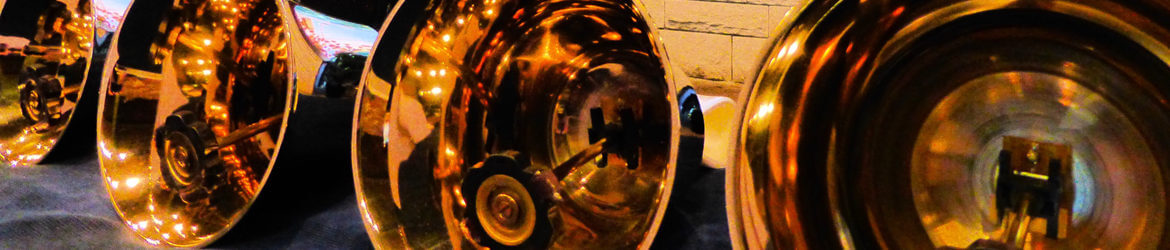
Beautiful Lilies (hymn tune: LILIES) is an Easter hymn from the turn of the twentieth century. The Easter lily is a symbol of resurrection, and symbolizes the trumpet of victory that proclaims that Jesus has risen from the grave. Our arrangement for three octaves of handbells has a charm that will keep the song in …
Tag: handbell choir
A handbell choir is an ensemble of handbell musicians, each of whom usually has a specific subset of the entire set of bells assigned to them. The group members play the entire score by their combined efforts via a unique type of teamwork where expression and musicality are dependent on the ensemble members fusing their efforts to form a greater whole.
The sets of handbells played by handbell choirs vary in size, usually stated as an integral number of octaves. For instance, a three-octave bell choir uses notes from C4 to C7, while a seven-octave choir plays C2-C9.
Handbell choirs also use additional instruments, the most notable being handchimes. Handchimes bring a different sound to the mix, and are used for effect and contrast. Other ancillary instruments include, flute, trumpet, clarinet, and percussion; of the percussion family, the cajón is perhaps one of the more popular recent additions.
Jan 22
Lift High the Cross (CRUCIFER) (Handbells, 3 to 5 octaves, Level 3-)
Lift High the Cross undoubtedly is most frequently sung in churches at Easter (and maybe on through Pentecost), but the message of salvation through Christ rings true the whole year round. Our arrangement for three to five octaves of handbells will be a welcome addition to your repertoire. Refrain: Lift high the cross, the love …
Jan 15
Mack the Knife (Handbells, 5-8 octaves, plus handchimes, 3 octaves, Level 5)
Bertolt Brecht and Kurt Weill wrote Mack the Knife in 1928 for the Threepenny Opera. Louis Armstrong, Ella Fitgerald, and Bobby Darin performed it, guaranteeing its place in our music social awareness. It’s such a happy, bouncy song that you’d hardly know it was talking about a hit man. But the legend lives on, and …
Jan 10
Mahler Swing (Handbells, 5-8 octaves, plus handchimes, 2 octaves, Level 5)
I fell in love with Mahler’s symphonies a long time ago. They’re gigantic works which stretch the limits (so far…) of how musical expression can be built. As of the twentieth century, they represent the pinnacle of orchestral composing. Mahler’s first symphony is about an hour in length (around three times the length of Mozart’s …
Nov 16
Angels We Have Heard on High (GLORIA) (Handbells, 3 octaves, Level 2-)
Angels We Have Heard on High is based on the nineteenth-century French song Les Anges dans nos Campagnes and is traditionally sung to the hymn tune GLORIA. The lyric tells us of how the angels came from heaven to celebrate the birth of the Christ Child. Our three-octave handbell arrangement is a very accessible Level …
Oct 13
Go, Tell It on the Mountain (GO TELL IT) (Handbells, 3 octaves, Level 3-)
The birth of the Christ Child has been an occasion for great joy for centuries. Go Tell It on the Mountain gives us both the command to proclaim the coming of the Savior as well as a song by which to declare it. Our new Level 3- arrangement is for three octaves of handbells, and …
Oct 05
Angels, from the Realms of Glory (REGENT SQUARE) (Handbells, 3 octaves, Level 2)
Angels came from heaven to celebrate the birth of Christ. It’s amazing to compare how it must have been in God’s glorious presence with the humble stable of Bethlehem. Yet they came, and they marveled! This new arrangement for three octaves of handbells is perfect if you have a relatively novice group, or if you …
Sep 26
Lo, How a Rose E’er Blooming (ES IST EIN ROS’) (Handbells, 3 octaves, Level 1)
Lo, How a Rose E’er Blooming dates back to sixteenth-century Germany. Its lyric combines the image of Jesus Christ as the Rose of Sharon and the Root of Jesse, plus the traditional impression of celebrating Christmas in winter. It was translated to English by Theodore Baker in the nineteenth century. Our arrangement for three octaves …
Sep 22
Smiles (Handbells, 5-8 octaves, plus handchimes, 2 octaves, Level 5)(Bay View Week of Handbells 2023)
The song Smiles has a long and wonderful history. T. Will Callahan wrote the lyrics in a Bay View cottage near the end of World War I, and it went on to be a tremendous hit, selling about 5,000,000 print copies (before the existence of public radio, or television, or the internet). The connection to …
Aug 14
Escape from No-Note Island, for five to seven octaves of handbells, Level 5
Here’s the story behind this new original handbell composition, Escape from No-Note Island: Handbell compositions are usually written for note ranges that constitute complete octaves of bells. Having this agreed-on convention between manufacturers, composers, publishers, and performers makes it easier to maintain consistency within the ringing art. For instance, “five octaves” refers to the range …